Showing posts with label New York. Show all posts

Friday, June 3, 2016

Early Emigrants: Sophie Sager -a woman before her time Part 2


Sophie's ordeal had made her aware of the lack of  legal rights for women and especially single unprotected women. She becan holding pulic lectures advocating for better womens rights first 1849 in Stockholm and later Uppsala and in the following years she visited Malmö,Gothenburg and Copenhagen.

She got a lot of audience, mostly young men but often met with  criticism because of her lack of “ladylike behaviour” Sophie  was ahead of its time and deviated from the ideal of the  passive, good womanhood. She had dared to do that no one else before her had done, namely, to use police force to defend their right not to be assaulted.. Maybe she was considered to forward  as she frequently advertised their activities in the press. 

her litterary production was little and and her talent lacking . Among her works include: Emanciperade fantasier i vers och prosa(Emancipated fantasies in verse and prose) 1850)
 Fonsterbarnets avslöjande genealogi (Pictures from life or Foster Child and its genealogy) (1852).

Sophie's thoughts were not revolutionary. She believed in the institution of marriage but thought women should have the right to a good education and to move freely in the community without having to bow to unnecessary conventions or be molested.


Emigration and life in the US
In1854 Sophie emigrated to the United States. She sailed with the bark Columbia from Hamburg with 200 German emmigrants. and arrived in New York August 5, 1854 In the lists of arrival she is listed as seamstress with her she had a two and a half year old child, if it was her own child, or if she has a child on behalf of another is not clear .


In 1855 Sophie married   the German music professor Eugene Adolphe Wiener (ca1813-1888). They had two  sons, Gabriel (1856-1932) and Victor Bolivar (1862-1932) The family settled in New York most of the time at different addresses in Brooklyn
Inthe Us federal census Census 1860 Sophie's husband is listed as music professor and in 1870 he is listed as as pianist and Sophie as musician
In 1861 Sophie published a pamplet called Woman's Destiny and Man's Duty Sophie and her husband separated around 1878 around 1878. In the mid and late 1880s Sophie held lectures on various topics, for example feminism, often her piano playing son Victor Bolivar performad with her, In 1887 Victor married a s girl of modest family background .She that was not good enough,for him according to Sophie who told the local newspaper, The Brooklyn Daily Eagle that he couldhave married a girl worth 60 000 dollar .. In 1888 Sophie became a widow according to the newspaper, he had devoted much of his time to think about a strategy how people could avoid bumping into each other on the street. 1893 Sophie suggested in the nespaper that passenger ships that sailed across the seas to oughto always sail in pairs if there were an accident they should be able to assist eachother.
Funeral and death
Sophie Sager died February 28, 1901 in her residence at 151 Jefferson Avenue in New York, According to the death certificate, she was 76 years old .She was buried two days later at her husband's side at the Greenwood Cemetery. According to an obituary d she was a famous lecturer
A year later, February 26, 1902 a memorial service over her was held inover her in the Swedish-American Bethlehem Lutheran Church in Brooklyn by Pastor J Jacobson.
The late memorial service supposedly gave rise to the rumor she'd died in 1902 Sophie's two sons died in 1932 Gabriel was unmarried, Victor had 4 children reaching adulthood

Sophie was ridiculed in her own time by her contemporaries.Today she is often seen as a early pioneer in the fight for womens rights. An her cause that a woman have the right to go unmolested in the public sphere is as actual now as it was then. However, Sophie was according son Gabriel against women's suffrage Today there is a street named after her in Enskededalen outside Stockholm.

Saturday, March 12, 2016

Ship Disasters: Austrias fire September 13, 1858 Part 3


The Aftermath


Austria started burning at about the level of 45 ° 01'N 41 ° 30'W about midway between Newfoundland and the Azores. the burned out wreck  probably drifted for a while before it sank to the bottom (Austrias wreck site)

 Austrias wreck  created a stir on both sides of the Atlantic, primarily in the USA and Germany, and newspapers reported extensively about the disaster.

 On 3 November 1858 The Hamburg city  Senate conferred .the Hamburgian honorary gold medal to Captain Ernst Renaud of the  Maurice and C A Funnemaityrk of  the  Caterina and honorary medal in silver to 4 other crew members for  the rescue of the surviving passengers.

 Charles Rosene jr  returned to his mother and siblings  in Richmond, Virginia, about 1870 he settled  in New York where he worked as  an actor .He  married at least two times and had seven children. According to the US Federal  census in 1900 he  was  retired and living with his family in Manhattan He died 1911 in New York  at an institution for the mentally ill .

The fate of  Charles (Claes)  Högqvist, Sven Nilsson and Swen Peterson remains  unknown they  probably remained  in USA.

 H C Andersen deeply mourned Henriette Wulff .  She had been  one of his closest friends,and  she had been like a sister to him. With her death his wish to visit USA  vanished since he became scared of the sea voyage . He wrote a poem in her memory in seven stanzas published in the danish newspaper Dagbladet, on October 22, 1858.


In Åby parish the pastor  wrote in the note on Carolina Nilsdotter emigration to America in the margin of the church examination rolls  "perished  during voyage   to America  Sep 13th 1858"

The news of August Theodor Mankées death reached both   his family in Stockholm and the ba ptists in Rock Island,  his two small  daughters were send  to the family in Stockholm where they grew up. One moved back to Chicago while the other became a clergyman's wife on the island of Gotland.

 Carl Johan Holmberg's gold nugget was taken  from his dead body and sent to his sister in Sweden

Anders Viktor Lindstein remained in the USA a few years after the sinking of the Austria but returned to  Sweden. around 1861. He remained unmarried  and lived a quiet life .Han worked as inspector at an ironmill  but was active in the Swedish Sharpshooter movement in Falun in 1860-thies.  He died in 1890 in Falun and was buried in Stora Kopparberg.but by then the disasater of the  Austria had  slipped into history's oblivion.

Friday, January 29, 2016

Shipping disasters: Austrias fire 13 September 1858 Part 2


The Fire 

After taking up the English passengers in Southampton  Austria sailed out onto the Atlantic .The journey  was relatively uneventful since ther was  headwind the ship was  estimated to arrive in New York a little  later than expected.
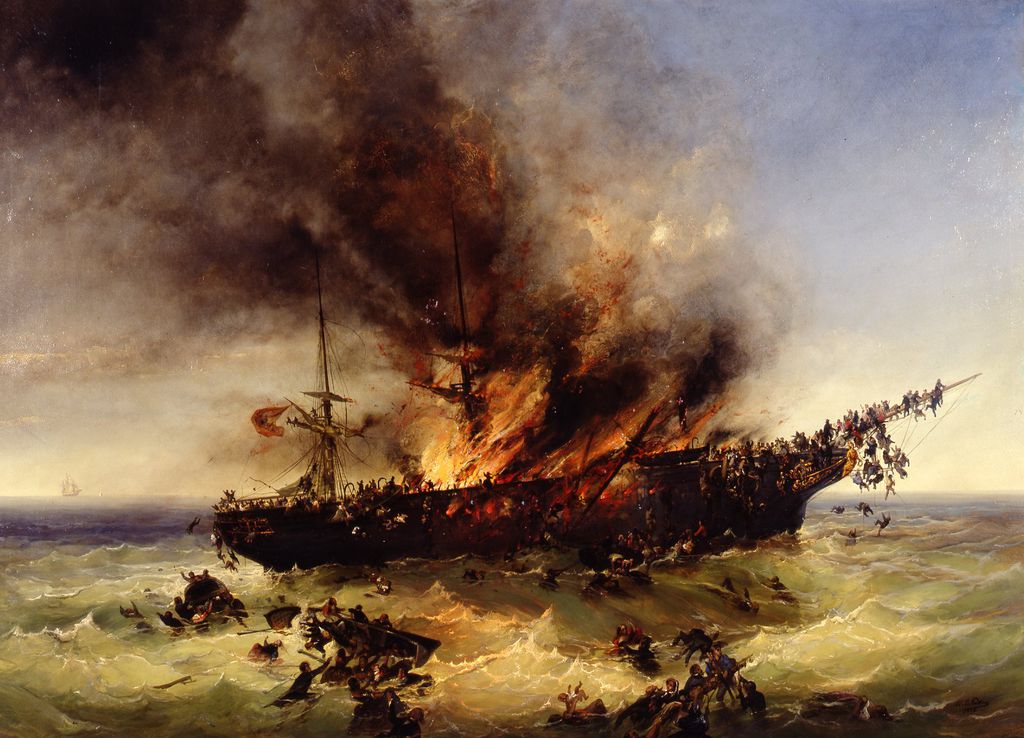
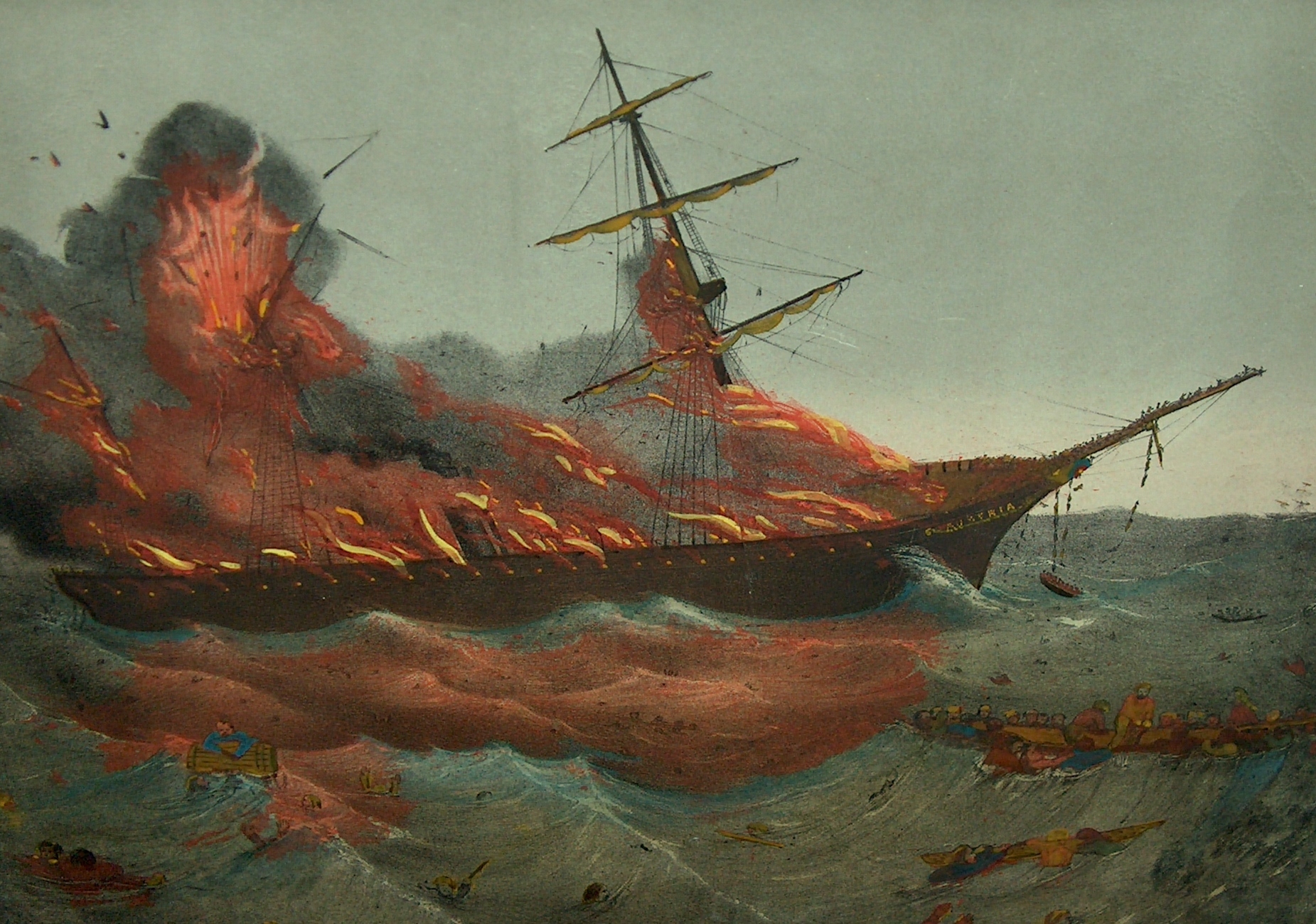
At noon on September 13 it was decided to fumigate  the sterage, by smoking it by dipping a red  hot chain into a bucket of tar. The chain soon  became too hot for the boatswain to hold and dropped onto the deck, which immediately caught fire. Soon  the cry was heard:
Feuer! (Fire !!)
Although the ship traveled only at half speed, it was impossible to stop the  steam engines since  enginecrew had become  asphyxiated   by the  smoke.
As the helmsman and the captain abandoned the ship,  the ship swung into the wind, which further allowed the fire to spread along the ship, devouring the  the mahogany veneer and varnished bulkheads and painted shots. The propeller could not be stopped and the rudder became useless.
Panic broke out on board. The passengers who did not suffocate  by the smoke were burned to death by fire or drowned when they jumped overboard to escape the flames.  Others died when they were drawn into the rotating propellers.
Anders Victor Lindstein told:
The horrible scene at the ship's fire is difficult to describe, you can make yourself an idea about it at the thought that out of 600 people, only 89 became saved. I saw mothers take their children, whose clothes already on fire, and throw them into the sea before  plunging  themselves into the waves


Charles Rosene and his son Charles Jr. had been sitting near the engineroom when the fire broke out. Charles, Jr. told:
:My father and I ran forward to escape the fire and was followed by the other passengers. I saw the fire penetrate through the valves within 10 to 15 minutes came the call to the lifeboats!
The panic-stricken passengers struggled to get space in a lifeboat, but disarray prevailed
Several lifeboats were launched but . but drove off before anyone had time to rise.
When the firstofficer took a knife and cut the ropes that held one of the lifeboats  it fell into the water, the passengers that were  inside were thrown out and the boat filled with water Charles Jr. ended up in the water but managed along with some others get  into the boat, it  however, turned over several times and  more people fell out and drowned.
Charles Sr.clinged to the boat for a short while but then lost his grip , and disappeared into  the waves. Claes Högqvist clung to one of Austrias lifebuoys for several hours before he could be helped into the lifeboat.
The first vessel to observe the disaster was the French bark Maurice which  immediately rushed to help.  Att seven in the evening arrived at the burnt ship and could rescue the first survivors.fromthe lifeboat.   The next morning the Norwegian sailing ship Catarina picked up the remaining  survivors who clung to the charred hull or were  floating on wreckage nearby  while the charred remains of the burned-out ship was left to sink.
Anders Lindstein was one of the last people pulled alive from the water.., his friend Carl Johan Holmberg was hanging dead on the bowsprit, where he had tied himself. In total, only about 90 people were  rescued of the ships  originally about 540 occupants.