Showing posts with label Stockholm. Show all posts

Monday, August 2, 2021

Helena Ulfsdotter Snakenborg; A Swedish lady at the Elizabethan court


During the 16th century, both England and Sweden were ruled by the colorful royal houses Tudor and Vasa. Both families had seized power by force, both had colorful and ruthless and charismatic rulers such as Gustav I , Erik XIV , (John III and Charles IX in Sweden and Henry VIII and Elizabeth I in England. One of my distant relatives came to serve members of both.

British School 16th century _A young lady aged 21
 Possibly Helena Snakenborg WikimediaCommons

Helena (Elin) Ulfsdotter Snakenborg was probably born around 1548-1549 in Fyllingarum manor  in  the province of Östergötland as the daughter of Gustaf Vasa's councilor Ulf Henriksson Snakenborg to Fyllingaryd in Östergötland and Agneta Knutsdotter.Lillie.
Helena´s family was a branch of the old noble family Bååt (Boat) that sometimes used the 
name Snakenborg wich came from Helenas fathers paternal grandmothers side of the family. Since the Swedish nobility were just beginning using family names in the 16th century Helena would sign herself as Helena or Elin Ulfsdotter (daughter of Ulf.)

Tre Kronor The old royal castle in Stockholm (burned 1697)
The Stockholm residence of the Swedish royal family and Helena
Snakenborgs workplace as a maid of honor to princess Cecilia
of Sweden.
The castle in a painting from 1661 by Govert Dircksz Camphuysen.
WikimediaCommons

Helena was one of the youngest of her parents  six children. Due to her father's position as a member of the Privy Council of Sweden, she probably already came into contact as a child with first the elderly miserly king  Gustaf I  and later the young handsome  ambitious but mentally unstable  Erik XIV court. Helena was  of the same age as Gustav I:s  three youngest children Sofia, Anna and Karl (Charles IX), perhaps they were brought up together at the royal castle Tre Kronor in Stockholm. 

Erik XIV, 1533-1577, king of Sweden (Steven van der Meulen) - Nationalmuseum - 38906
Portrait  of swedish king Erik XIVsent to Queen Elizabeth I of England,
 to further the negotiations regarding the marriage. By 
Steven van der Meulen 1561
WikimediaCommons

Erik XIV had big plans for his future marriage. As early as 1559, he sent his younger brother Johan (John III) at the head of a delegation to England to propose to its new queen Elizabeth I. The delegation was well received but Elizabeth very civilly  declined.
Erik did not give up and  contact between the courts continued. Princess
Cecilia Erik and Johan's younger sister admired Elizabeth and began to correspond with her, expressing a desire to visit her in England.

Princess Cecilia Gustavsdotter Vasa of Sweden
unknown artist: WikimediaCommons


In 1564 the political situation in Sweden had taken a dramatic turn. King Erik had thrown his brother Johns and Johns  new bride into prison. Princess Cecilia naturally was upset by this and protested. She was  anxious to leave Sweden and visit England with her new husband Markgrave  Christopher of Baden-Rodemachern .

In the early autumn of september of 1564  the couple  left Stockholm   together with a large group of courtiers including the now 15-year-old Helena Snakenborg as one of her  maids of honour Due to the war with Denmark, the entourage had to travel over Finland, Livonia, Poland, Germany and the Netherlands. After a stormy crossing the they   landed in England and on September 12th  they made their  magnificent entry  into London.

Princess Cecilia was wearing a black velvet dress with a mantle of silver fabric. studded with pearls. and her maids of honour  including Helena wore dresses  in crimson and coats of the same fabric and colour. For Helena, the arrival to London must have been overwhelming. With about 100,000 inhabitants, London was one of Europe's largest cities  more than 10 times larger than Stockholm. Elisabeth I's court was with its splendor one of the most sophisticated in Europe.

The Darnley Portrait Elizabeth I ar. 1575
 National Portrait Gallery WikimediaCommons

Princess Cecilia and her entourage were initially well received by the Queen, who became the godmother of Cecilia´s eldest son Edward Fortunatus, born a few days after her arrival in London and named  after the Queen's younger  brother Edward VI. However Cecilia's wastefulness soon  caused   tensions in her relationship with the Elizabeth I. A life-changing event for Helena came when a prominent courtier William Parr first Marquis of Northampton 1513-1571 fall in love with  her.

William Parr First Marquess of Northampton
by Hans Holbein the Younger Royal Collection WikimediaCommons

William Parr was the brother of Catherine Parr 1512-1548 Henry VIII sixth queen and thus Elizabeth I's stepmother. He had a complicated  private life. He was a newly widowed  but his first wife Anne Bourchier, whom he divorced  twenty years earlier, was still alive and it was considered that he could not remarry as long as she was alive. We do not know what Helena felt about her 35-year-old suitor.  She must have been aware that a marriage with him would make her one of England's highest ranked ladies. She wrote to her worried mother in Sweden and emphasized his fine manner and high social position.

Princess Cecilia  and her husband had by this time hastily left England to escape her large  debts.Her debtors sized all her and her maid of honours clothes. The angry Cecilia woved revenge on England and Elizabeth ! 

Helena remained in England.  Queen Elisabeth I , had become attached to the young girl and  secured Helena a position  at court by appointing her as one of her maids of honour.
Life at the Elizabethan  court,despite all the luxuries, was often stressful. Elisabeth I was a charismatic queen but also moody with outbursts of anger as she could also beat  her favorites at court. Helena's  experience of   serving members of the fierce and suspicious Vasa  dynasty certainly came in handy.

In 1568 in  Sweden the political situation had changed once more . King Erik XIV had descended into mental illness and been deposed by his brother John III who seized the throne. Erik XIV  would later  die in prison in  possibly killed by being  given peasoup spiced with arsenic !

It was probably during this time that the first portrait considered to depict her was painted (see top of page). She wears a white petticoat with red flowers under a red petticoat. On her head she has a white floral beret adorned with a white and a red feather.

Helena and William  Parr married in May 1571, after the death of his first wife, the Queen attended the wedding which took place  the Queen's Closet  in Whitehall Palace. Helena became  a widow when her husband died after just four month of marriage. William Parr died with big debts which the queen  had to pay.

After her husbands death Helena returned to the royal court as one of Elizabeth I s ladies in waiting  As the dowager marchioness  of Northampton, Helena was the highest ranking lady  at court after Elizabeth I and the queens cousin lady Margret Douglas  Helena returned as a widow to her service as a lady in waiting  to the Queen and it was at the court that in the mid 1570s she met the man who became her second husband Sir Thomas Gorges 1536-1610.


Portrait of Sir Thomas Gorges (1536-1610)
of Longford Castle in Wiltshire,
 a courtier and Groom of the Privy Chamber to Queen Elizabeth I
Wikimediacommons.

Thomas Gorges was one of Queen Elisabeth's chamberlains. Through his kinship  with the powerful Howard family, he was related by both Queen Elisabeth's mother Anne Boleyn and her third stepmother Katherine Howard.

Despite his kinship  to the queen Thomas Gorges was not considered to be of the same rank as Helena, since he did not yet have his own noble title. Elizabeth I who chose to live unmarried was extremely reluctant to allow her courtiers to marry. This was probably what made Helena and Thomas marry in secret in 1576. The queen was furious and banished Helena from the court and threw Thomas Gorges into the Tower of London!

However, the queen soon forgave the newlyweds and allowed them to return to court. Helena and Thomas Georges Marriage seems  have been harmonious and resulted in eight children of whom six  lived to adulthood. The time the couple did not spend at the  royal court, they stayed at Longford Castle near Salisbury in the county of Wiltshire in southwest England. During their time, the property was expanded into a magnificent castle inspired by the Swedish Vasa castles


Longford Castle front
Longford castle in Wilthshire Peter, CC BY 2.0 , via Wikimedia Commons 

.The diplomatic relations between England and Sweden in the  1570-thies was a bit  tense. The princess Cecilia had returned to Sweden and settled in the city of Arboga . She send privateers out the Baltic where they sized the cargo of English ships.The princess meant that she had the right to keep the cargo as compensation for the property she had lost to her debtors  when she left England in 1566. 

In  1582  Thomas Gorges lend an embassy  to Sweden where he also met members of the Snakenborg family. As far as we know, Helena never returned to Sweden after her move to England. But she corresponded with  her mother and siblings, one of her brothers was present at her first husband's funeral in 1571.

In 1580ties  he Elizabeth I rewarded  Helena and her husband  with the Sheen property for their lifetime.  Sheen was located near the Richmond Palace, the queen's main residence, which allowed the spouses to live with the children even when they were in court.

Richmond Palace, west front, drawn by Antony Wyngaerde, dated 1562
WikimediaCommons

Helena remained Elizabeth's close confidant and, due to the Queen's faltering health often had to represent the queen on official occasions  at the end of the 1590s. At the Queen's funeral in 1603, she walked  closest to the coffin  as the highest ranked female mourner  present.


Helena Snakenborg, Marchioness of Northampton, 1603

Helena Snakenborg, Marchioness of Northampton, 1603
Helena Snakenborg widow marquis of Northampton in that costume
she bore at James I coronation 1603 artist Robert Peake the Elder
WikimediaCommons


Helena and Thomas Gorges attended the coronation of the new King James I in 1603 at Westminster Abbey in London. Helena was portrayed by the artist Robert Peake the Elder in the magnificent red dress adorned with ermine she wore at the coronation.

After Thomas Gorge's death in 1610, her Helena increasingly withdrew from the center of power of which she had been a part since her arrival in England 45 years earlier. She returned to court a few times to assist in diplomatic negotiations with Sweden over a possible marriage between the princess Elizabeth  and the Swedish prince Gustavus Adolphus son of Helenas childhood friend king  Charles IX which was never completed due to the opposition of the princess mother queen Anne of Denmark.


Helena Snakenborg lady Gorges detail of grave monuments in
 Salisbury Cathedral h
original photo: tudorqueen6.com


She had a varied life to look back on and a large family to worry about. According to a contemporary writer, she had 92 descendants at the time of her death! Helena died on 10 April 1934 at the age of 86 at Longford castle and was buried next to Thomas Gorges under a stately monument in Salisbury Chatedral (No bad career for a girl from Östergötland)!


Salisbury Cathedral (St. Mary) (14674778559)
Monument and effigies, in Salisbury Cathedral, Wiltshire,
 of 
Helena Snakenborg (d.1635) and her second husband
Sir Thomas Gorges (1536–1610). Erected after her death in 1635


Web links and sources


Videos:


Claire Ridgeway from The Anne Boleyn Files talks about Helena Snakenborg


Claire Ridgeway and her dog Teasel speaking about maids of honour  and ladies in waiting at the court of Elizabeth I.


A video with views from Longford Castle built by Helena and her second husband Thomas Gorges


Web links

in  english

Helena Ulfsdotter Snakenborg in Svenskt Kvinnobiografiskt Lexikon (Swedish Encyclopedia of women)
Helena, Marchioness of Northampton  art.by Gunnar Sjogren Published in HistoryToday Volume 28 Issue 9 September 1978

Family of Queen Katherine: The Death of the Marchioness of Northampton blogpost Posted on  by Tudorqueen6   


in Swedish

Snakenborg, släkt, urn:sbl:6081, Svenskt biografiskt lexikon (art av Hans Gillingstam), hämtad 2021-05-2


Helena Snakenborg: Drottning Elisabeths sängkamrat Art.by Birgitta von Heland Published in Populär Historia 5/2002


Literature:

in Swedish

Helena Snakenborg: en svenska vid Elisabet I: s hov / Gunnar Sjögren. 1973

Fiction

in english

Roses have Thorns a novel about Helena Snakenborg by Sandra Byrd 2013


Triology about Frances Gorges the daughter of Helena Snakesborg dotter
 by  Tracy Borman 


Friday, June 3, 2016

Early Emigrants: Sophie Sager -a woman before her time Part 2


Sophie's ordeal had made her aware of the lack of  legal rights for women and especially single unprotected women. She becan holding pulic lectures advocating for better womens rights first 1849 in Stockholm and later Uppsala and in the following years she visited Malmö,Gothenburg and Copenhagen.

She got a lot of audience, mostly young men but often met with  criticism because of her lack of “ladylike behaviour” Sophie  was ahead of its time and deviated from the ideal of the  passive, good womanhood. She had dared to do that no one else before her had done, namely, to use police force to defend their right not to be assaulted.. Maybe she was considered to forward  as she frequently advertised their activities in the press. 

her litterary production was little and and her talent lacking . Among her works include: Emanciperade fantasier i vers och prosa(Emancipated fantasies in verse and prose) 1850)
 Fonsterbarnets avslöjande genealogi (Pictures from life or Foster Child and its genealogy) (1852).

Sophie's thoughts were not revolutionary. She believed in the institution of marriage but thought women should have the right to a good education and to move freely in the community without having to bow to unnecessary conventions or be molested.


Emigration and life in the US
In1854 Sophie emigrated to the United States. She sailed with the bark Columbia from Hamburg with 200 German emmigrants. and arrived in New York August 5, 1854 In the lists of arrival she is listed as seamstress with her she had a two and a half year old child, if it was her own child, or if she has a child on behalf of another is not clear .


In 1855 Sophie married   the German music professor Eugene Adolphe Wiener (ca1813-1888). They had two  sons, Gabriel (1856-1932) and Victor Bolivar (1862-1932) The family settled in New York most of the time at different addresses in Brooklyn
Inthe Us federal census Census 1860 Sophie's husband is listed as music professor and in 1870 he is listed as as pianist and Sophie as musician
In 1861 Sophie published a pamplet called Woman's Destiny and Man's Duty Sophie and her husband separated around 1878 around 1878. In the mid and late 1880s Sophie held lectures on various topics, for example feminism, often her piano playing son Victor Bolivar performad with her, In 1887 Victor married a s girl of modest family background .She that was not good enough,for him according to Sophie who told the local newspaper, The Brooklyn Daily Eagle that he couldhave married a girl worth 60 000 dollar .. In 1888 Sophie became a widow according to the newspaper, he had devoted much of his time to think about a strategy how people could avoid bumping into each other on the street. 1893 Sophie suggested in the nespaper that passenger ships that sailed across the seas to oughto always sail in pairs if there were an accident they should be able to assist eachother.
Funeral and death
Sophie Sager died February 28, 1901 in her residence at 151 Jefferson Avenue in New York, According to the death certificate, she was 76 years old .She was buried two days later at her husband's side at the Greenwood Cemetery. According to an obituary d she was a famous lecturer
A year later, February 26, 1902 a memorial service over her was held inover her in the Swedish-American Bethlehem Lutheran Church in Brooklyn by Pastor J Jacobson.
The late memorial service supposedly gave rise to the rumor she'd died in 1902 Sophie's two sons died in 1932 Gabriel was unmarried, Victor had 4 children reaching adulthood

Sophie was ridiculed in her own time by her contemporaries.Today she is often seen as a early pioneer in the fight for womens rights. An her cause that a woman have the right to go unmolested in the public sphere is as actual now as it was then. However, Sophie was according son Gabriel against women's suffrage Today there is a street named after her in Enskededalen outside Stockholm.

Friday, May 27, 2016

Early Emigrants: Sophie Sager -a woman before her time Part 1


Sophie Sager
Among the earliest  Swedish emigrants was  also a female pioneer whose career took her from the swedish countryside to the dangerous sides of Stockholm and later  across the Atlantic to Brooklyn.New York.  The first woman held public  lectures on women's rights.
and sued a man for assault and battery in her own name.


Childhood and adolescence
Sophie Lisette Sager came from a  family  of  industrialists .Born in 1825 in Byarum ,Jönköping county, the daughter of  Gabriel Sager and his second wife Johanna Bergenholz. After her father's death in1834, the family went broke .and in1840 they had to move to the poorhouse  .Sophie education came to depend on the charity of relatives. According to Sophie she later had to earn a living as a governess and companion.

In 1848 a relative paid for Sophies  travel by steamboat to Stockholm and for her stay there in order to learn fine needlework. It  was Sophies plan to open her own dress shop in Stockholm.
Her  experiences in the shady suroundings there, would turn her life upside down, and drive her on to the public stage.


The trip to Stockholm The Sager case
After her arrival Sophie took lodgings with a shoemakermaster family Dillström in Bollhusgränd in Stockholms Old city. Bollhusgränd was already in the late 18th century known to be a prostitution district.  After rows and quarrels with mrs Dillström who had an illigal tavern and wanted Sophie to be at the guests disposal,
Sophie was forced to move and managed, thanks to a certain stable manager Gustaf Adolf Möller , to find lodgings with his housekeeper.Lovisa Ström.  Sophie soon  discovered that miss Ström  was Möller’s mistress and also engaged in prostitution under the cover of “receiving needlework”. Before long, Sophie  also had a nocturnal visit, . The visit was energetically rejected. The stable manager then began a sexual siege of the dismissive Sophie , which ended with attempted rape and assault.

Sophie managed to escape and was tended to by a doctor Johan Eric Brisman  who helped her report Möller to the police and documented her injuries. The long and detailed statements to the court Sophie Sager wrote herself, and she represented herself before the court.
The statements were thus the first of Sophie Sager’s writings to be published. They reveal a reality that her contemporary female authors probably never had any personal contact with and did not write about. Stockholm’s nocturnal world of bars, prostitution, and general immorality. Möller was convicted and scandalised and left Stockholm  in 1849.

The trial was  a sensation and  extensively written about in the  Stockholm newspapers.
and the documents concerning the trial were printed as a book Sagerska målet (The Sager case)


Saturday, March 12, 2016

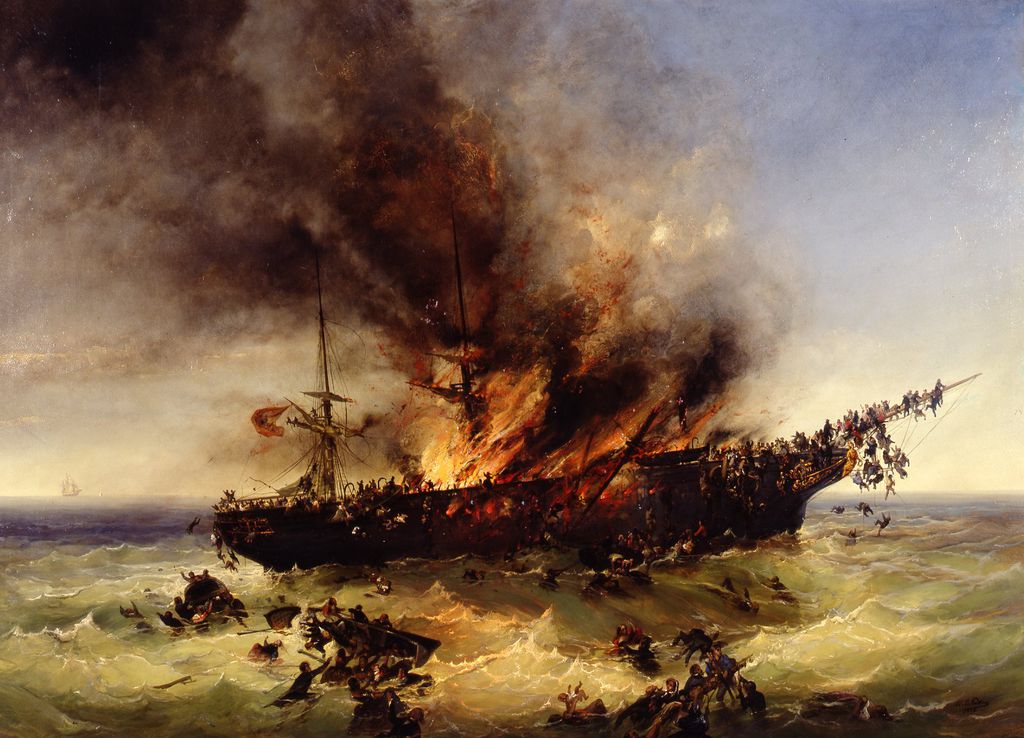
Ship Disasters: Austrias fire September 13, 1858 Part 3


The Aftermath


Austria started burning at about the level of 45 ° 01'N 41 ° 30'W about midway between Newfoundland and the Azores. the burned out wreck  probably drifted for a while before it sank to the bottom (Austrias wreck site)

 Austrias wreck  created a stir on both sides of the Atlantic, primarily in the USA and Germany, and newspapers reported extensively about the disaster.

 On 3 November 1858 The Hamburg city  Senate conferred .the Hamburgian honorary gold medal to Captain Ernst Renaud of the  Maurice and C A Funnemaityrk of  the  Caterina and honorary medal in silver to 4 other crew members for  the rescue of the surviving passengers.

 Charles Rosene jr  returned to his mother and siblings  in Richmond, Virginia, about 1870 he settled  in New York where he worked as  an actor .He  married at least two times and had seven children. According to the US Federal  census in 1900 he  was  retired and living with his family in Manhattan He died 1911 in New York  at an institution for the mentally ill .

The fate of  Charles (Claes)  Högqvist, Sven Nilsson and Swen Peterson remains  unknown they  probably remained  in USA.

 H C Andersen deeply mourned Henriette Wulff .  She had been  one of his closest friends,and  she had been like a sister to him. With her death his wish to visit USA  vanished since he became scared of the sea voyage . He wrote a poem in her memory in seven stanzas published in the danish newspaper Dagbladet, on October 22, 1858.


In Åby parish the pastor  wrote in the note on Carolina Nilsdotter emigration to America in the margin of the church examination rolls  "perished  during voyage   to America  Sep 13th 1858"

The news of August Theodor Mankées death reached both   his family in Stockholm and the ba ptists in Rock Island,  his two small  daughters were send  to the family in Stockholm where they grew up. One moved back to Chicago while the other became a clergyman's wife on the island of Gotland.

 Carl Johan Holmberg's gold nugget was taken  from his dead body and sent to his sister in Sweden

Anders Viktor Lindstein remained in the USA a few years after the sinking of the Austria but returned to  Sweden. around 1861. He remained unmarried  and lived a quiet life .Han worked as inspector at an ironmill  but was active in the Swedish Sharpshooter movement in Falun in 1860-thies.  He died in 1890 in Falun and was buried in Stora Kopparberg.but by then the disasater of the  Austria had  slipped into history's oblivion.

Friday, December 10, 2010

First post in Anna-Karins Genealogical podcast YouTube channel

I have uploaded the first little film in Anna-Karins Genealogical Podcasts YouTube channel.
it is a little film about the Swedish actress Emilie Högqvist 1812-1846. she was a popular actress in the 1830thies and 1840thies .One can almost say that she was a 19th century swedish eqvivalen of Marilyn Monroe. since she was for time mistress to king Oscar I (before he became king).
She was a contemporary of the famous swedish singer Jenny Lind.

Saturday, June 19, 2010

Swedish Royal Weddings: Crown princess Victoria to Daniel Westling June 19th 2010 part 1

At last the wedding of Crown princess Victoria and Daniel Westling took place in Storkyrkan just beside the Royal Palace in Stockholm.. The wedding day was the culmination of 3-4 days of festivities. I have tried to find some You Tube clips to show you everything what went on

The day before the wedding(June 18th) there was a big gala consert at the Concert Hall in Stockholm were a lot of Swedish singers and artists celebrated the princess and her fiance among the artists were the group Roxette (Per Gessle and Marie Fredriksson who performed their song The Look


In the beautiful Ending of the consert a lot of singing children came up to salute the crown princess (about 3 min. into the video)


Thursday, June 17, 2010

Crown princess Victoria Marries on Saturday june 19


On Saturday June 19 th Crown princess Victoria daugthter of King Carl XVI and queen Silvia will marry Mr. Daniel Westling from Ockelbo.
Crownprincess Victoria is the royal couples eldest child (and heir to the throne) she is born in 1977. Daniel Westling is born 1973 in Örebro but grew up in Ockelbo.

Around 2001 he met crownprincess Victoria when he worked as her personal trainer the became a couple soon after. The couple became engaged in 2009 feb 24

The wedding will be held in Storkyrkan close to the royal palace in Stockholm. The wedding date has historical significance. In 1976 June 19 king Carl Gustaf and queen Silvia was married . There were also royal wedding on the same dates in 1823 and 1850. I will try to post a bit more on the wedding later.

Parts of the royal wedding can be seen Live and on the we at Swedish Televisions Royal Wedding site at

http://svt.se/detkungligabrollopet; (in Swedish)

The official wedding site (english version)

http://www.royalcourt.se/royal…..60315.html


Thursday, March 26, 2009

First Episode of "Who Do you think you are" on Swedish TV


The first episode of The swedish version of "Who do you think you are"(Vem tror du att du är) on the Swedish Television channel TV1 was broadcasted on March 24th. The first episode featured actress Helena Bergströms ancestors.
The program consentrated on some of Helena Bergström female ancestors her paternal grandmother who was a ballet dancer before her marriage as well as a paternal great aunt who was a modell to a famous sculptor in the late 19th century.
The program also contained information about the common practise of taking fosterchildren wich was a common way for married women in the working class to contribute economically to their familys upkeep.
Unmarried mothers had few possibilities to take care of their children on their own and to place them in fostercare was their only alternative.
Since Helena Bergströms paternal grandmothers family lived in the Stockholm area since the late 19th century the sources used were Stockholm sources often kept by the Stockholm city archive. To be able to se the program on webb TV please click here

The next episode of the program will feature former minister of justice Thomas Bodströms ancestors.